Historical landmark
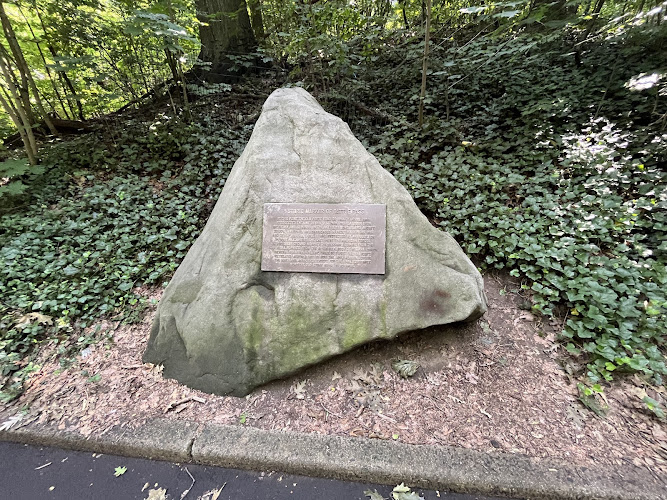
Battle Pass Historic Marker
About this place
Discover Battle Pass Historic Marker
Battle Pass Historic Marker
The Battle Pass Historic Marker, situated within Brooklyn's Prospect Park, New York, stands as a testament to a pivotal moment in American history—the Battle of Long Island, fought on August 27, 1776. This commemorative plaque not only honors the sacrifices made during the Revolutionary War but also serves as a focal point for understanding the strategic significance of the area during the conflict.
Historical Context
In the summer of 1776, the American colonies were embroiled in a struggle for independence from British rule. The Continental Army, led by General George Washington, faced a formidable British force intent on quelling the rebellion. New York City, with its strategic harbor, was a focal point for British military operations.
The Battle of Long Island, also known as the Battle of Brooklyn, was the first major battle after the Declaration of Independence. It was a significant engagement that tested the resolve and capabilities of the Continental Army. The British aimed to capture New York City and sever the New England colonies from the rest of the rebellion.
The Battle Pass and Its Significance
The Battle Pass, formerly known as Flatbush Pass or Valley Grove, is a historic hill pass that played a crucial role during the Battle of Long Island. Located within the Heights of Guan, the pass was a strategic route that connected the towns of Brooklyn and Flatbush. This area was traversed by the Native American trail Mechawanienck, which preceded the Kings Highway (later becoming Flatbush Road). The pass served as a natural corridor through the otherwise rugged terrain, making it a focal point during the battle.
During the battle, American forces under General John Sullivan were positioned at Battle Pass, a strategic pass through the Heights of Guan. They had two cannons stationed on the eastern Redoubt Hill, providing artillery support. The Hessian troops, led by Leopold Philip de Heister, advanced from the south with a force of about 5,000 soldiers. The American defenders constructed barricades, including the felling of the Dongan Oak, a significant tree, to impede the Hessian advance.
Despite these efforts, the American forces were flanked by British troops arriving via the river, leading to General Sullivan's capture. Many American soldiers retreated across what is now the Long Meadow, joining other troops for a final stand near the Old Stone House of Gowanus. This retreat and subsequent engagements marked a significant chapter in the Revolutionary War, highlighting the challenges faced by the Continental Army in defending their positions.
The Dongan Oak Monument
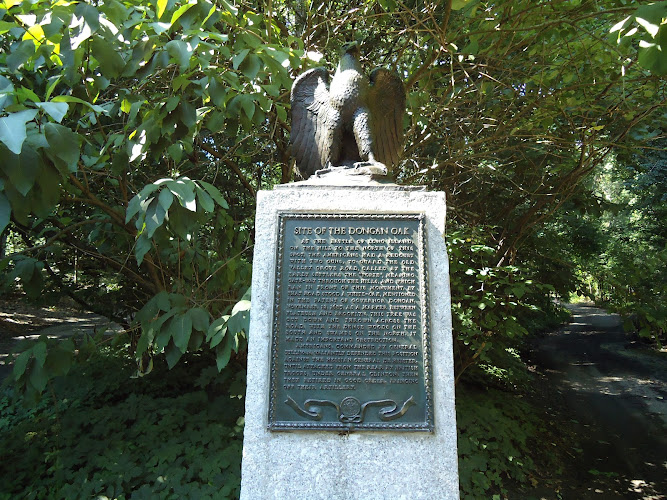
Central to the Battle Pass Historic Marker is the Dongan Oak Monument, which commemorates the boundary tree felled by American forces to slow the British advance. This monument, dedicated in 1922, features a bronze eagle atop a stele and was designed by sculptor Frederick Ruckstull. The original eagle was stolen in the 1970s and again in the 1990s but has been replaced both times by the Prospect Park Alliance. The monument serves as a poignant reminder of the ingenuity and determination of the American forces during the battle.
Preservation and Commemoration
The preservation of the battlefield was one of the reasons given for the creation of Prospect Park. The park's design incorporated the natural landscape to honor the historical significance of the area. The Battle Pass runs for about 150 feet along the car-free East Drive inside the park, allowing visitors to traverse the same path once taken by soldiers during the Revolutionary War. The area is marked by the Dongan Oak Monument and other historical markers, providing a contemplative space for reflection on the events that transpired.
An emphasis on naturalistic landscape architecture in the park's original design discouraged a large memorial, and as a result, the site is relatively understated today. However, the presence of the Dongan Oak Monument and the Battle Pass Historic Marker ensures that the sacrifices made during
Location